
Showing posts with label Teaching. Show all posts

Tuesday, April 14, 2015

Shemini - Narnia and the Vilna Gaon: On Choosing Literature for our Children

Reading in the Park
My eleven year old daughter has recently been reading the classic Narnia series by C. S. Lewis. I asked her if she had finished the first book, The Lion, the Witch, and the Wardrobe, and, after confirming that she had, I went on to inform her that C. S. Lewis was a Christian theologian, and that the Narnia series is heavily based on Christianity. In particular, I told her that Aslan, the "Lion" of the title, is actually intended to represent Jesus, that his death on the Stone Table is intended to represent the crucifixion of Jesus, and that his return to life is intended to represent the resurrection of Jesus.

Unsurprisingly, my daughter was not pleased to learn these things. In fact, she was somewhat distraught, saying that she didn't want to read a Christian book. While I certainly understood why this bothered her, I told her that the Christian elements were there whether she knew it or nor, and that she was better off knowing they were there than not. In fact, as the conversation developed, I pointed out that all non-Jewish fiction includes problematic elements of non-Jewish thinking, even when they are not explicitly religious. (This is also true for a great deal of "Jewish" fiction, including many of the books published by Orthodox publishers.) On the contrary, the most problematic literature is precisely that literature where the problematic elements are subtle and inconspicuous. When you read a book with an obvious agenda, you instinctively raise your guard and you challenge the assumptions and assertions in the text that endorse that agenda. But when the agenda is not obvious to the casual reader (as in the Narnia series), and even more so when the book truly has no agenda (because the author takes these premises for granted), then our guard is lowered and we are much more likely to accept the ideological, moral, cultural, and religious premises of the author without even realizing that we are being influenced.

This idea is alluded to in a teaching of the Vilna Gaon (פנינים משלחן הגר"א) in connection to the signs of a kosher animal. In Leviticus 11, the Torah tells us that a kosher animal must have two signs, it must have split hooves and it must chew its cud. The Torah then identifies four species that have only one sign, and which are therefore not kosher:

But, of the animals that chew their cud or that have split hooves, you shall not eat the following: the camel, because it chews its cud but does not have split hoves, is unclean to you. And the hyrax, because it chews its cud but does not have split hoves, is unclean to you. And the hare, because it chews its cud but does not have split hoves, is unclean to you. And the pig, because it has split hooves, and is cloven-footed, but does not chew its cud, is unclean to you. (Leviticus 11:4-7)
Midrashically, these four species are identified with the four "exiles" of the Jewish people: Babylonia, Persia, Greece, and Rome. (ויקרא רבה יג:ה) The exile of Rome, which continues until today, is associated with the pig, which has the superficial sign of kashrus (split hooves) but lacks the inner sign (chewing the cud).

The Talmud (Yoma 9b) states:

מקדש ראשון מפני מה חרב? מפני ג' דברים שהיו בו ע"ז וגלוי עריות ושפיכות דמים וכו' אבל מקדש שני שהיו עוסקין בתורה ובמצות וגמילות חסדים מפני מה חרב? מפני שהיתה בו שנאת חנם, ללמדך ששקולה שנאת חנם כנגד שלש עבירות ע"ז גלוי עריות ושפיכות דמים וכו'
ר' יוחנן ור"א דאמרי תרווייהו ראשונים שנתגלה עונם נתגלה קצם, אחרונים שלא נתגלה עונם לא נתגלה קצם. אמר רבי יוחנן טובה צפורנן של ראשונים מכריסו של אחרונים.
Why was the first Temple destroyed? Because of three sins that were in its time: Idolatry, sexual immorality, and bloodshed. ... But, in the time of the second Temple, when they were busy with Torah, mitzvos, and acts of benevolence, why was it destroyed? Because of the sin of unjustified hatred that existed at that time. This teaches that the sin of unjustified hatred is equal in severity to the three sins of idolatry, sexual immorality, and bloodshed.
Rabbi Yochanan and Rabbi Eliezer both said, "For the earlier people (i.e. the exiles of the first Temple), whose sins were revealed, the end (of their exile) was revealed. (The prophet told them that they would return after 70 years.) For the later people (i.e. the exiles of the second Temple), whose sins were not revealed, the end (of their exile) was not revealed." Rabbi Yochanan said, "The fingernail of the earlier ones was greater than the belly of the later ones."

The Vilna Gaon
The Vilna Gaon sees in this final statement of Rabbi Yochanan, about the "fingernail" and "belly" of the two generations, an allusion to the two signs of a kosher animal. The early generations are compared to the animals lacking the external sign of kashrus, the split hooves, in that their sins were open and acknowledged, whereas the later generations are compared to the pig, which has the superficial sign of kashrus, but does not chew of its cud, an internal process that is largely hidden from view. Thus, the generation of the first Temple, whose sins were revealed and acknowledged, was punished less severely than the generation of the second Temple, which maintained the superficial appearance of righteousness, but was internally sinful.

The essential point of the Vilna Gaon was summed up by Rav Dovid Tevele of Lissa (in a famous Shabbos HaGadol drasha in 1782, in which he condemned the proposed educational reforms of Naphtali Herz Wessely):

שהרשע המגלה רשעתו ירחיקו העם ממנו ולא ילמדו ממעשיו אבל הרשע אשר הרשעה טמונה בקרבו הוא לאבן נגף ולצור מכשול אשר יתלכדו העם אחריו והביטו אחר דבריו אשר במרמה ידבר.
The people know to distance themselves from an openly wicked person, and they do not learn from his actions, but a wicked person whose wickedness is hidden within is "a stone of stumbling and a rock of offence" who ensnares the people to follow him and to pay heed to his deceitful words.

Often, the biggest dangers are the least obvious, precisely because they are not obvious, and they therefore fail to elicit the normal protective responses against a threat. This is true in every area of life, including, perhaps especially, in the education of our children. While we certainly need to carefully screen the literature and entertainment that we expose our children to, we have to bear in mind the the biggest threats to be found in these areas are not necessarily the obvious ones. While we obviously shouldn't expose our children to outright immorality, the real challenge is often in the apparently "innocent" and "harmless" materials that we often expose our children to without hesitation.

For many parents, including myself, the natural gut reaction to this is to insist that our children only be exposed to purely "kosher" materials. Unfortunately, while this might be the ideal, I do not believe this is a realistic option for our children. Whether we acknowledge it or not, all of our homes, even the most insular, are permeated with the influences of the non-Jewish world. In the world in which we live today, there is no truly effective way to completely shut out the values, mores, and ideas of the non-Jewish world surrounding us. (As I mentioned earlier, more often than not, even ostensibly Orthodox Jewish literature carries such baggage within it.) As such, a simple policy of restricting our children's exposure is not only futile, but ultimately dangerous, as it fails to effectively train our children to recognize these influences and deal with them. So, while a certain degree of screening is certainly necessary, our general approach has to be to teach our children how to read (and watch) critically, from a proper Torah perspective.

Of course, this requires, first and foremost, a very strong Torah education. As the Sages teach us in Pirkei Avos, "הוי שקוד ללמוד תורה, ודע מה שתשיב לאפיקורוס" - "Be diligent in studying Torah, and know what to answer the non-believer." The first priority must always be Torah study. Nevertheless, in our generation, I believe it is also necessary for our children to have some exposure to non-Jewish literature, carefully guided, so that the children learn to read and think critically about such material. I readily acknowledge that this is not necessarily an easy thing to do, and that it requires a great deal of effort on the part of parents and teachers. However, I believe that this is the only truly responsible and effective approach in our time and place.


Friday, June 29, 2012

20 Classic Gedolim Pictures

The following is a series of "traditional" depictions of famous rabbinic figures. Please bear in mind that some of the depictions (such as the picture of the Baal Shem Tov) are known to be incorrect, and many - especially of the earlier figures - are probably completely imaginary.

Rav Yitzchak Alfasi - The "Rif"

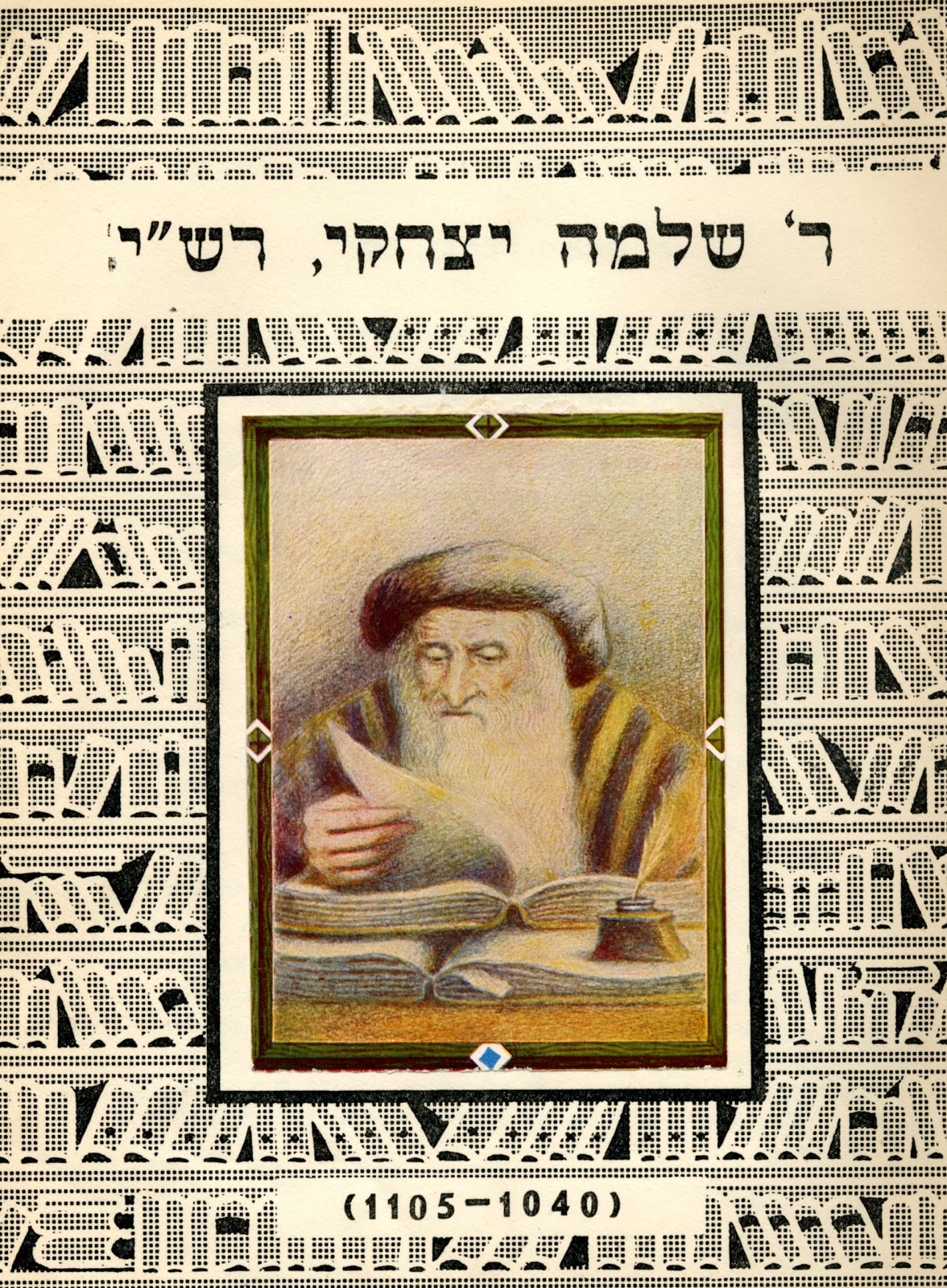
Rav Shlomo Yitzchaki - "Rashi"

Rav Yaakov b. R' Meir - "Rabbeinu Tam"

Rav Moshe ben Maimon - The "Rambam" (Maimonides)

Rav Moshe ben Nachman - The "Ramban" (Nachmanides)

Rav Asher ben Yechiel - The "Rosh"

Rav Yaakov ben Asher - The "Baal HaTurim"

Rav Don Yitzchak Abarbanel

Rav Yitzchak Aboav - The "Menoras HaMeor"

Rav Yosef Karo - The "Beis Yosef"

Rav Moshe Isserles - The "Rema"

Rav David ben Shmuel HaLevi - The "Taz"

Rav Shabsai HaKohen - The "Shach"

Rav Avraham Gombiner - The "Magen Avraham"

Rav Tzvi Ashkenazi - The "Chacham Tzvi"

Rav Yonason Eibschutz

Rav Yisrael Baal Shem - The "Baal Shem Tov"

Rav Eliyahu of Vilna - The "Vilna Gaon" or "Gra"

Rav Akiva Eiger

Rav Moshe Sofer - The "Chasam Sofer"

Wednesday, June 27, 2012

On Gedolim and "Daas Torah"

The following was originally written for grade school students (5th-8th grade) as an introduction to a school wide "Gedolim" project. The goal was to introduce the concept of "gadlus" and Torah leadership, and to counter some of the misconceptions that many children (and adults) have in this area. It has been modified somewhat for a general audience:


A gadol (lit. "great person" - referring to a great Torah leader) is a Jew that has perfected himself. This means that he has striven with his entire being to truly fulfill the expectations that God has for every Jew. Every gadol started out as an ordinary person. Every Jew is capable of gadlus, and God expects all of us to strive to perfect ourselves.

Gedolim are not carbon copies of each other. Although a great Torah sage has subjected his entire personality to the purifying light of Torah, it remains his personality, not a generic “gadol” personality. Like everyone else, each gadol has his own unique personality and character traits, his own unique interests, and his own sense of humor. By studying the Torah, internalizing its message, and fulfilling God’s mitzvos, the gadol has freed his personality from the slavery of the yetzer hara – the natural urges and temptations that prevent us from being who we really want to be. The Torah enables us to be ourselves in the truest sense.

Nevertheless, there are several basic characteristics that are essential to the status of a gadol. Each of these characteristics is one that the gadol has striven to perfect in himself. Gedolim are made, not born.


Basic Characteristics of a Gadol

The following is a list of characteristics that we all must strive to achieve. A gadol is simply a person who has already done so.
  • Torah Knowledge – A gadol must be a master of Torah knowledge. He must have a comprehensive knowledge and familiarity with the Torah. In particular, he must be knowledgeable in the Talmud and Poskim. Even more important than the amount of book knowledge he possesses - which is very important - the gadol must become a master of how the Torah “thinks”, i.e. he must develop a broad understanding how the Torah deals with various types of issues.
  • Mesorah – The gadol must have a genuine commitment to the mesorah – the interpretation of the Torah as it has been passed down from generation to generation since Moshe received the Torah at Sinai. He expresses this commitment in his study of the Torah and in teaching it to the next generation of students.
  • Self-Mastery – A gadol is a person who has developed complete control over himself. He is a master of self-discipline, in which every act, every statement, and every reaction, is measured and trained according to the Torah. He is a person that has worked on all of his middos (character traits) to perfect them to the greatest degree possible.
  • Ahavas Yisrael­ - Love of One’s Fellow Jew – A gadol has developed in himself a genuine love for every Jew. He truly fulfills the mitzvah of “V’Ahavta l’rei’echa kamocha” – “Love your fellow as yourself.”
  • Genuine Ruchnius (Spirituality) – A gadol has a real relationship with God. He doesn’t just “believe” in God; he knows God. He has true ahavas Hashem and yiras Hashem (love of God and fear of God). He sees an aveira as truly harmful and destructive, a mitzvah as truly beneficial and constructive. When a gadol prays, he truly feels that he is standing in the presence of the Creator of the Universe and that he is speaking to Him, and that He is listening. When a gadol studies Torah, he truly feels that God is speaking to him in the words of the Torah.
  • Anava - Humility – The middah of anava is of unique importance. Anava does not mean seeing yourself as lowly and worthless. Rather, it is the opposite of self-centeredness. The natural state of human being is to be self-centered, in that we care only about ourselves. As a person grows spiritually, he becomes less self-centered and cares more about others. The gadol has developed his personality so that his own self-interest is no longer an obstacle to his spiritual development and care for others. In truth, anavah is an essential prerequisite for all the previously mentioned traits.
A gadol is not a hermit or a monk. He doesn’t exist in some otherworldly, mystical realm. A gadol lives a full, normal life. He has a family, a wife and children, and he cares for them just like any husband and father. He is part of a community – with neighbors and friends. He has a job – frequently, but not always, as a teacher of Torah – and co-workers. He pays taxes, buys gasoline for his car, uses a credit card, etc. In other words, he has the same challenges in his life that everyone else has.


Daas Torah – The Torah Mind

Every community requires leaders who are capable of making decisions on behalf of the community as a whole. To be made properly, such decisions require much more than simple competence in the specific topic at hand. Leadership is not simply about making the best pragmatic decision. A leader needs to be able to make decisions that properly reflect the values of his community. This is true not only for determining the goals that the community should be striving for, but also, perhaps more importantly, the means that should be used to achieve those goals and the prioritization of values. In reality there is no such thing as a purely pragmatic or practical decision. All decisions are reflections of values.

Of course, the ability to make intelligent decisions that reflect the values of the community is only the beginning. The ideal leader must also be genuinely motivated to do the best he can for his community and he must be able to rise above the self-interests and biases that can prevent a person from making proper decisions.

Given these requirements, it should be obvious that a gadol is uniquely qualified to be a leader of the Jewish people. This is due to all the characteristics we already mentioned:
  1. He is a master of Torah knowledge and methodology.
  2. He has a genuine commitment to the continuation of the mesorah.
  3. He can think clearly without any “static” from bad middos.
  4. He genuinely cares about his fellow Jews.
  5. He has true emuna (belief) in God.
  6. He is not self-centered and self-serving.
As Torah Jews, we believe that God controls the entire world. A person with a true “Torah mind” – what is popularly called Daas Torah – has the clearest insight into what God wants us to do in any situation. A gadol has developed his mind so that it functions entirely according to Torah. Before rendering a decision on any matter, a gadol will gather whatever information is necessary. Depending on the issue, he may consult with experts in various fields. The gadol will then process this information with his Daas Torah and come to a conclusion. This final decision will be based purely on Torah reasoning and instincts as applied to the particular circumstances.

Added to this is the fact that gedolim, having developed a true relationship with God, also benefit from a special siyata d’shmaya – “Heavenly assistance” – in their thinking. This is a unique insight that is akin to ruach hakodesh.

This does not mean that all gedolim will always agree on every issue. Gedolim may disagree because of they have received different information, because they have different perspectives, or many other reasons. It also doesn’t mean that a gadol will always make the best possible decision. Wisdom is a gift from God and He will sometimes withhold that gift even from those closest to Him. Ultimately, gedolim are still human beings, and like all people - including the most talented leaders - they can err. Nevertheless, the best possible choice to render decisions for the Jewish people is a gadol.

Our gedolim are leaders and teachers, but, perhaps most importantly, they are models and exemplars. A gadol demonstrates what the Torah means when it say that we are all created “b’tzelem Elokim” – in the image of God.” Our study of gedolim should motivate us to achieve greatness in our own lives.

Wednesday, June 6, 2012

I Want YOU to Love your Fellow Jew!

I made this into a poster for my classroom several years ago:

Chofetz Chaim Poster

Sunday, February 19, 2012

Yiush Shelo M'Daat - The Movie

A few years ago, while I was teaching in Politz Day School, we were studying Eilu Metzios, one of the chapters of the Talmudic tractate, Bava Metzia, which deals with the laws of lost objects. One of the main issues discussed in this chapter is the concept of yi'ush shelo m'daas - "giving up hope (for regaining a lost object) without conscious intent." It's not a simple concept, especially for 12-13 year olds, and as it is a very long and complex discussion, it was important that the students properly understand the basic issues at the outset.

In a brainstorming session, the principal suggested that I make a little "movie" with the class, that would help them get all the details straight in their mind. I was very hesitant at first, as I had never done anything like this, but I agreed to try it out. So, after a little planning - mostly to figure out what I was capable of reasonably achieving without specialized software - this little video was the result. The initial video started right out from the story, but afterwards people wanted a version that could be used by the general public, so I added a two minute introduction.


It turned out that I had created a monster, as the video was a big hit within the school. The school arranged for me to show the video at the local JCC, and from there it went on to be shown at a local Jewish film festival. Not quite what I had expected when I made the silly thing.

The movie is a good example of what a person can do with a little creativity, even without specialized software. Unfortunately, as an educational technique, "movie making" is of limited utility. Not every topic lends itself well to the approach, and if you do it too often it loses much of its novelty (which is its main appeal).

(For those who are familiar with the Talmudic discussion, it should be noted that the conclusion is greatly oversimplified. In reality, the halacha would play out almost exactly the opposite from what happens in the film. According to the opinion that yi'ush shelo m'daas is yi'ush, the court would, in most cases, require the item to be returned to the original owner based on the principle of lifnim m'shuras hadin (which is often enforceable in hashovas aveida cases). According to the opinion that yi'ush shelo m'daas is not yi'ush, the court would generally not be able to return the lost objects to the original owner for the simple reason that he can not prove that he is, in fact, the owner. (If he could, then there would be no issue of yi'ush shelo m'daas in the first place.) Rather, the finder would have to hold the object as an agent of the original owner until such evidence is provided. The only way this could realistically happen would be if there had been witnesses to the original loss that the owner had been unaware of. In short, it's a complicated topic.)

Sunday, February 5, 2012

The Challenge of Davening in School

Anyone who has taught in a Jewish day school knows that (starting from about seventh grade) one of the most difficult things to teach is "davening" (prayer). The simple reality is that talking in a foreign language to an invisible being does not come naturally to many young people (or old people, for that matter). This creates a situation where students are often, at best, completely "spaced out" through the entire davening. Davening becomes a social event where everyone catches up on what happened since the last time they saw each other. (Sound familiar, grown ups?)

In the long term, we need to work with the students on their understanding of prayer as a concept (what is prayer, why do we pray, what does it accomplish, etc.) and also work on their understanding of the meaning and significance of the specific prayers. All of this needs to be built on a basic foundation of belief in God and His relationship with us. This is a long process (ultimately, it is a life-long process), in which prayer itself plays an important role. Like many things, prayer is something we learn by doing as much as by studying.

In the short term, much depends on the specific situation and every educator needs to find creative ways to deal with their own situation. One of the most important elements is not to have unrealistic expectations. As a general rule, it is not reasonable to expect young teenagers to fully relate to davening. This is especially true when the adults around them don't appear to take davening all that seriously either.

As I mentioned above, in my experience, one of the main challenges with davening in school is that many students have extraordinary difficulty refraining from socializing with their peers during davening. I found that, for some of these students, if some kind of arrangement was made ahead of time so that they would sit separately from their peers, within a short time many of these students would begin to actively participate.

Another thing that can very effective is to have the students be actively involved in "running" the minyan (if you have one) as chazanim, baalei kriah, gabbaim, etc., with the adult(s) acting only in a passive, supervisory role. The more responsible a student feels for the proper functioning of "his" minyan, the more likely he is to buy into the whole thing.

One project that I found to be very successful in increasing student participation was what I called the "Kol Ram Club." I taught the students about the importance of answering "amen" out loud, as well as the relevant halachos (esp. no yelling!). I then tracked each student on a daily basis if I observed him appropriately answering "amen" out loud. The tracking was done on a chart on the wall of the classroom. After a two week period (5 school days a week), if the student had gotten at least 7 (out of ten) days of answering out loud, he got a "star" on the chart and a doughnut. Once a student earned four stars (which took a minimum of two months), he got a fancy certificate (made by me) stating that he was a "four-star" member of the "Kol Ram Club."
"Official" Logo of the Kol Ram Club
The project had a huge impact. The minyan felt more "alive" and active, students weren't as "spaced out", and the general tone of the entire davening was improved. (The certificates also turned out to be highly prized items.) It is a classic example of how minor changes can have a disproportionate impact. I did this project with middle school students, so I'm not sure how well it would go over in a high school. Of course, everything depends on presentation.

Tuesday, January 24, 2012

The Incredible Adventures of Mr. Bowman


I made this several years ago for my students when we were studying Mesechta Megilla, 22b. It started off as a simple set of stick figure illustrations for the sugya about different forms of bowing and the related laws. (The ability to draw decent stick figures is incredibly useful for a rebbi.) 


But then I got a little carried away.

Maybe a good sequel would be when Mr. Bowman meets his nemesis, the evil sorceror, Kuma Zakufa!

Monday, January 16, 2012

Twenty-Four Challenges & Twenty-Four Answers

Recently, while learning with my chavrusa (t/y Torah Mates), we looked up the famous story of the Talmudic sages Rav Yochanan and Reish Lakish (בבא מציעא פ"ד ע"א). The story is one of the most tragic and difficult stories found in the Talmud, and needs careful study to properly understand. In the course of reviewing the story, I was struck by a new insight. 

At one point, the story tells how, after the death of his close disciple, friend, and brother-in-law, Reish Lakish, Rav Yochanan suffered terribly. In an attempt to comfort Rav Yochanan, the sage, Rabbi Elazar ben Pedas, came to sit as a disciple before Rav Yochanan as a replacement for Reish Lakish. For every statement of Rav Yochanan, Rabbi Elazar ben Pedas would bring support from earlier sources. Rav Yochanan then said to him, "Are you like ben Lakish? On every thing I said, he would challenge me with twenty-four difficulties, and I would answer with twenty-four answers, and in this manner the teaching would be expanded. And you bring me proof? Do I not know that I am correct?"

What struck me for the first time in my recent review of this story was Rav Yochanan's statement that for Reish Lakish's twenty-four questions, he had to give twenty-four answers. Usually, when, in studying a Talmudic sugya (topic), we find ourselves with several difficulties, the likelihood is that most, if not all, of the difficulties are based upon one or two basic errors that we made in our study. While they may go unnoticed initially, as the sugya progresses, the difficulties caused by these errors begin to snowball, and at the end we find ourselves with a whole series of problems. A more experienced scholar will often be able resolve most of our difficulties by simply pointing out the basic error we made early on in the sugya. 

Moreover, while he may not be able to resolve the difficulty on his own, a highly competent student will usually be able to work his questions back to their underlying premises and recognize where the core difficulty lies. Such a student will ask fewer questions, but his questions will be much more focused and productive.

If R' Yochanan had only said that Reish Lakish would ask twenty-four questions, this could have meant nothing more than that Reish Lakish had difficulty following R' Yochanan's teachings and was therefore always left with numerous questions. However, when R' Yochanan says that each of the twenty-four questions required a separate answer, this indicates that every single question was fundamentally distinct. Reish Lakish had thoroughly analyzed the teaching, and had located twenty-four separate problem areas, each of which had to be dealt with on its own.

The more I think about this, the more it amazes me.

Monday, January 2, 2012

Why Study Jewish History? Part 2 - Learning the Lessons of the Past

The Torah makes it clear in numerous places that an historical awareness – consciousness of the past – is a fundamental aspect of Judaism. Thus, for example, we have the daily obligation of remembering the Exodus from Egypt, and many other such commandments – such as the Sheish Zechiros[1] many people say after morning prayers[2] – and, of course, we have the various holidays and fast days that commemorate historical events.

The basic reason for this emphasis on the past is because, fundamentally, our entire belief in God and His Torah is based on historical events like the Exodus from Egypt and Matan Torah (lit. "the Giving of the Torah", i.e. the Revelation at Sinai). However, we don't only remember the positive events of our past, we also remember the errors (such as the sins of the golden calf and the spies) and the tragedies (such as the destruction of the first and second Temples). There is an actual mitzvah d’Oraisa (Biblical obligation) to remember the sin of the golden calf and also to remember the sin of Miriam. The purpose of remembering these events is so that we can learn from them.[3] This is also the primary purpose of fast days.[4] For this reason, the Jewish Scriptures and works of the Sages do not sanitize Jewish history. On the contrary, Scripture will frequently exaggerate the sins of our ancestors so that we can learn from them.


In his introduction to his edition of Seder HaDoros, Rav Naftali ben R’ Avraham Maskil L’Eisan (1829-1897)[5] writes that this is one of the most important purposes of studying history:
הנסיון הוא ראש המורים בכל ענין אשר נתן אל האדם לענות בו תחת השמש, ראשון הוא לכל נותני לקח טוב ללמד להועיל, ומה יכלכלו ימי חיי אנוש הקצרים לצבור לו נסיונות איש איש לנפשו ודור דור לבדו? אך דור לדור יגיד נסיונותיו, אבות לבנים יודיעו, ובניהם לדור אחרון, כרבות הדורות ירבו הנסיונות וכספות ימות עולם תרבינה הידיעות והבחינות. כל מקרה וכל מעבר אשר יעבור על גוי ועל אדם יחד יורה דעה לבאים אחריו איך יאחזו אשוריהם. כל מכשול וכל תקלה, כל סבה וכל מסובב, יביא לבב חכמה לדור יבוא לעשות כמתכנתו או להנזר ממנו, בכל חכמת בינה, בכל מלאכת מחשבת, ובכל הליכות החיים. זכרון מפעלות הצדיקים ופרי מעלליהם אשר יאכלו המה נר לרגלי בני האדם ואור לנתיבתם, ועלילת רשעי ארץ ותוצאותם למות ולאבדון הם מוסר תוכחה לאחרונים לבל יזידו ללכת בעקבותם
Experience is the chief teacher in every matter that a man must deal with in this world. It is the primary giver of beneficial good teachings. What would the brief lives of men suffice to gather experience for each individual person and each generation by itself? Rather, each generation recounts its experiences to the next, fathers tell their sons, and their sons tell the following generation, and as the generations increase, the experiences accumulate, and as the days of the world gather, knowledge and insights increase. Every event, every barrier that is passed, whether for a nation or an individual person, educates those who come later on how to emulate their success. Every obstacle and mishap, every cause and effect, brings wisdom to the coming generation enabling them to do it correctly or avoid it. So it is in every art of wisdom, every skilled craft, and in all the ways of life. The memory of the acts of the righteous and the beneficial fruits of their deeds are a candle before the feet of men and a light for their path. Whereas the deeds of the wicked and their results in death and destruction are a reproof of admonishment for those who come later to not wickedly follow in their footsteps.

[1] The “Six Remembrances” – This refers to six Biblical commandments to constantly remember certain facts. These are (1) to remember the Exodus from Egypt (Deuteronomy 16:3), (2) to remember the revelation at Sinai (Deuteronomy 4:9-10), (3) to remember the war with Amalek (Deuteronomy 25:17-19), (4) to remember the sin of the golden calf (Deuteronomy 9:7), (5) to remember the punishment of Miriam (Deuteronomy 24:9), and (6) to remember to sanctify the Sabbath (Exodus 20:8). With the exception of the last, all of these are commandments to remember events from the past.

[2] The Sheish Zechiros are printed in most Jewish prayer books immediately after the morning prayers, and it is a widespread custom to recite them every day at that point.

[3] The philosopher George Santayana is frequently quoted, “Those who do not learn from history are doomed to repeat it.”

[4] See Mishna Berurah 549:1

[5] The early editions of Seder HaDoros had numerous printing errors and was almost unusable. Rav Naftali Maskil L’Eisan issued a corrected edition. Although his editing of the Seder HaDoros is generally considered to have been his most significant accomplishment, Rav Naftali Maskil L’Eisan may be best known as the author of the so-called "Malbim Haggada".

Why Study Jewish History? Part 1 - As an Aid to Torah Study

This is the first of a series of four posts on why the proper study of Jewish history is a very important part of the development of a true ben Torah (a Jew who is focused on Torah study). The focus in these posts will be on the importance of Jewish history for a Jew’s spiritual development. Each post will focus on one major aspect of this topic.

This material was originally written for a course in Jewish history given at a yeshiva high school. I have modified it somewhat for a broader audience.

History as an Aid to Torah Study


The study of history, especially of the period of Chazal (Chachmeinu Zichronom Livrocha – “Our Sages, may their memory be a blessing” – a term used to refer to the Sages of the Talmud), is very important as an aid for Torah study. In fact, most of the major history seforim were written for this purpose. Rav Yechiel Heilprin (1660-1746), in his great historical work, Seder HaDoros, explains in his introduction:
...דע לך כי תועלת ידיעת הדורות רב הוא... ואם תורתנו הקדושה, שאין בה יתור אות וקוצי, התחיל מבראשית, שלא היה צריך אלא בשביל רנון אומות שלא יאמרו לסטים אתם, כ"ש ידיעת הדורות ממש, כל גופי התורה והלכה פסוקה יתבררו עי"ז, שמן הצורך להיות רשום בלב כל נבון. ואם הראשונים, שלבם היה פתוח כפתחו של היכל ואולם..., עכ"ז ר' יוסי, שנימוקו עמו, עשה חבור על זה וקראו סדר עולם, אלא שקיצר מאד כי היה די לדורות ההם, אבל בדור העני בדעת... מרבוי הצרות... ונסתמו מעינות חכמה ובינה, לא די שנחתם ונסתם שבילי ים הש"ס, כי גם בתורה נביאים וכתובים אשר "למקרא בן חמש" אם הוא בן שבעים אין בו ממש וכעור באפלה ימשש... ע"כ ערכתי לפניך סדר הדורות
You should know that the knowledge of the generations is of great benefit…. If our holy Torah—which does not contain an extra letter or point—begins with Genesis, which is only necessary because of the accusations of the nations so that they shouldn’t say, “You are bandits!”,[1] then certainly the [history of the] generations [through which] all the basics of Torah and halacha (Jewish law) are made clear, must be imprinted on the mind of any intelligent person.[2] Furthermore, [even in the time of] the early generations, whose minds were open like the entry to the Temple, … Rav Yosi [ben Chalafta], "whose learning is with him"[3] nevertheless saw fit to write a book on [history] which he called Seder Olam,[4] although he wrote very concisely, for that was sufficient for those generations. However, in [this] generation which is poor in knowledge… because of the numerous troubles… and in which the springs of wisdom and understanding have been sealed, not only have the ways of the sea of the Talmud been sealed and shut off, but even with regard to Torah, Neviim, and Kesuvim (Tanach i.e. Scripture), [of] which [we are taught that] “a five year old begins the study of Scripture”[5], [even] seventy year old men have no knowledge and are like blind men groping in the dark…. For this reason I have assembled before you [this work], Seder HaDoros….

Rav Heilprin continues with a detailed discussion of the importance of this study and he gives many examples of the kind of errors in learning and halacha which can be made when one is ignorant of the order of the generations of the chachamim.

Similarly, the Vilna Gaon is quoted as recommending the translation of the Greek writings of Josephus Flavius, a Jewish historian who lived at the time of the destruction of the second Temple, because his writings can help us understand chazal and their times.[6]

A good basic knowledge of Jewish history is essential to any serious Torah scholar. Without it, a scholar will make many elementary errors in his understanding, and possibly even errors in psak halacha. As we shall see, in future posts on this topic, the study of Jewish history serves several other important functions for a Torah Jew as well.


[1] See Rashi on Genesis 1:1, that really the Torah could have begun with the mitzvos (commandments) and skipped the historical narrative of Creation and the Patriarchs, except to establish the legitimacy of the Jewish claim to the land of Israel so that the nations cannot accuse us of being robbers. For a full discussion of this issue, see Ramban and Nachalas Yakov on Genesis 1:1.

[2] Rav Heilprin’s reasoning is that if God is willing to insert historical information in the Torah just to respond to the accusations of the nations, then certainly we should be knowledgeable in that historical information that is necessary for our basic understanding of Torah and halacha.

[3] This was a special praise that was said of R’ Yosi ben Chalafta, see Gittin 67a and Avos d’Rabbi Noson 18.

[4] This refers to the classic rabbinic work, Seder Olam Raba.

[5] Avos 5:21

[6] The Encyclopedia L’Toldos Gedolei Yisroel (ערך ר' אליהו מוולנא) states:
ר' אברהם בן הגאון מספר שאביו הגאון אמר לו שהוא משתוקק לראות את ספרי יוספוס פלביוס מתורגמים עברית משום "שעל ידם נוכל לבוא אל כוונתם של רבותינו ז"ל בתלמוד ובמדרשים בדברם במקומות רבים בעניני ארץ קדשנו בימי קדם ההם."


Wednesday, December 28, 2011

Poster of the Mesorah of the Oral Torah

If you are about my age, this diagram may be familiar to you. It used to be found in many Chabad publications, and I assume that it was originally produced and published by Merkos L'inyonei Chinuch, the Chabad educational organization, as a classroom poster.

It's a great educational tool, laying out the basic mesorah (tradition) of the Torah. Beginning with Sinai and the Written Torah, it works through the Mishna, Talmud, and major poskim (authorities in Jewish law). I remember, as a young boy, that this poster was my first introduction to the existence of such important works as the Rif and Tur. In my experience, as a teacher, most middle-school students, even in good yeshivos, are often not familiar with this basic information.

For some reason, the poster is now very difficult to find. If anyone has any info about it, please let me know.

Thursday, December 22, 2011

"There were no Maccabees!"

One Chanuka, some years ago, I got a phone call from a student's mother who was a bit upset with me. She told me that the previous night her family had hosted a little Chanukah get-together and some of the guests knew very little about Chanuka. So she and her husband decided to display their son's Jewish education and asked him to give an impromptu speech about what he had recently learned about Chanuka. The young man, one of my students at the time (he was in 7th or 8th grade), being put suddenly on the spot, blurted out the one "fact" about Chanuka that he had apparently retained from the last couple weeks worth of lessons on the topic. "There were no Maccabees!" he declared. Of course, this rather shocked his parents, but, not being able to make heads or tails of this statement, the mother tried to shift to a safer topic, dreidel! Where did dreidel come from? "From the Germans!" declared my young student. 

Unsurprisingly, the parents were mortified, as was I, when I heard the story. As I explained to the mother, her son had partially picked up on (and remembered) some of the topics we had discusses in class - those that, in his mind, had "shock value" - without understanding them. I had told the class, at one point, that when we study the period of the Maccabees, we have to realize that the term "Maccabees" is an anachronism and that the people we call "the Maccabees" would not have recognized the term. There was only one man known as "the Maccabee" and that was the famous Judah the Maccabee. The use of the term "Maccabees" to refer to the entire Jewish rebel force that fought the Greeks developed later and primarily in non-Jewish circles.

As for dreidel, well what their son had said was actually correct, sort of. The dreidel game is simply a variant form of a gambling game popular in Europe, especially the German version of the game, and the letters on the side of the dreidel refer to the German/Yiddish terms for what happens when that letter comes up in the game. All of the famous commentaries about the dreidel - including the acronym נס גדול היה שם, "A great miracle happened there" - developed afterwards.

Why the dreidel game became customarily associated with Chanuka remains a mystery. Gambling games in general have become associated with Chanuka, even though there is no basis for this and rabbinic authorities have strongly condemned such activities. However, the dreidel doesn't seem to fall under condemnation even in these sources.

In any case, the incident brought out a point for me that I have yet to fully resolve in my own mind. On the one hand, a teacher has an obligation to teach the truth. This is obvious, of course, but there are times when the truth is complicated and students, especially the less attentive or less mature, may miss crucial pieces and end up even more confused than before. As in this case, the people we call the Maccabees certainly did exist, even though they weren't known by that name at that time. By attempting to give my students a more sophisticated understanding of the past, I had caused one of my students to think that the whole story was a myth. (I'm actually not sure what he thought, that never became clear.)

The problem is that there will always be some students who have difficulty with a level of complexity that the bulk of their peers are capable of handling. So, as a rebbi (a rabbi who teaches Judaic studies), I am forced to choose between leaving the bulk of my students with a simplistic understanding of Judaism that they have really outgrown, or with leaving some of my students with, at best, a confused understanding.